

What if the scientific account of how life developed and the biblical belief that God created it are not enemies, but two different ways of looking at the same reality?
I have never felt that I must choose between believing in creation and accepting evolution.
To me, evolution can be understood as the process through which God’s creation has unfolded. Science investigates the mechanisms and history of the natural world; faith asks what it means for that world to exist, and how we should live within it.
That is why I find the opening chapter of Genesis fascinating. Read alongside what we have learnt from astronomy, geology and biology, some of its images seem remarkably familiar. Others do not fit the scientific timeline nearly so neatly. I think both observations deserve an honest hearing.
I am not suggesting that the writer of Genesis possessed a hidden modern science textbook. But I do wonder: how could an account written thousands of years ago come so close to some of the broad stages that science describes today? And what happens if we stop treating each creation “day” as a 24-hour period?
A World Without Form (Genesis 1:1–2)
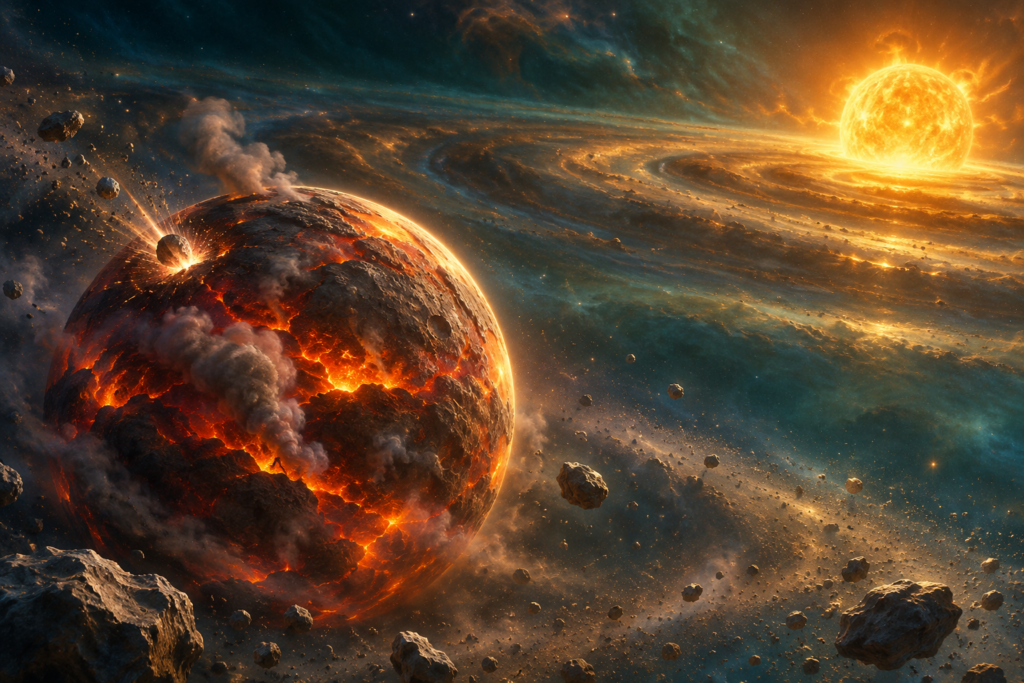
Genesis opens with God creating the heavens and the earth, before describing the earth as unformed, empty and dark.
I picture the beginnings of our universe and, much later, the birth of the solar system: gas and dust gradually drawn together by gravity, a young Sun, and material collecting into the planets. The earliest Earth was a violent place, repeatedly struck by other bodies and at times covered in molten rock.
That makes the image of a world not yet shaped into the home we recognise particularly evocative for me.
NASA explains that our solar system began around 4.6 billion years ago when a vast cloud of gas and dust collapsed under gravity. Most of the material gathered in the centre to form the Sun, while the remainder flattened into a rotating disc from which the planets took shape (NASA, n.d.b).
This helps me picture the movement from an unformed world towards an ordered solar system. Yet Genesis describes a dark watery deep, not a magma ocean, and the Sun formed before Earth in the scientific account. I see a meaningful parallel in the picture of a world not yet ready for life, rather than an exact geological description.
Let There Be Light (Genesis 1:3–5)
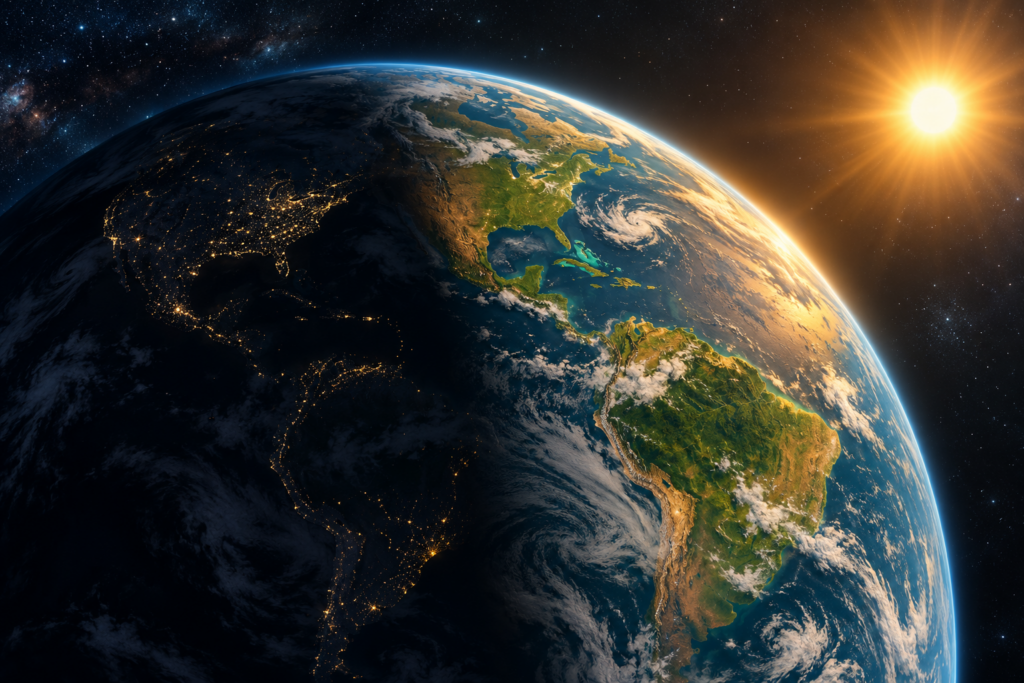
Next comes light and the separation of day from night.
I associate this with the young Sun and a rotating Earth. Day and night are indeed produced by the planet turning, with one side illuminated while the other faces away.
NASA’s guidance on planetary motion explains that a day is tied to Earth’s rotation on its axis, while a year comes from its orbit around the Sun (NASA, n.d.a). That distinction makes the biblical separation of day and night particularly vivid to me: it describes a familiar rhythm of the world, even though the passage does not tell us the mechanism that produces it.
Genesis does not mention Earth’s rotation, and it introduces the heavenly lights explicitly on the fourth day. Perhaps the chapter is interested less in chronology than in the creation of order and rhythm: light and darkness, day and night, times and seasons.
Waters Above and Below (Genesis 1:6–8)

The second day separates waters above from waters below by an expanse of sky.
When I read this, I think about the development of Earth’s atmosphere and water cycle. Gases released by the young planet helped form an atmosphere. Water vapour could condense, clouds could form, and liquid water eventually collected in oceans.
The Natural History Museum describes how Earth’s early conditions gradually changed as oceans formed and the atmosphere stabilised (Dunning, n.d.a). The US Geological Survey explains the present-day water cycle: water evaporates from seas and land, condenses into clouds in cooler air and returns as precipitation (USGS, 2019).
The Hebrew image of an expanse or dome separating waters reflects how people in the ancient world understood the sky, not a technical account of atmospheric physics. Still, with what we know today, I can see an echo of clouds, evaporation and rainfall in that distinction between waters above and below. That is my interpretation of the imagery, not evidence that the writer understood modern meteorology.
Dry Land Appears (Genesis 1:9–10)
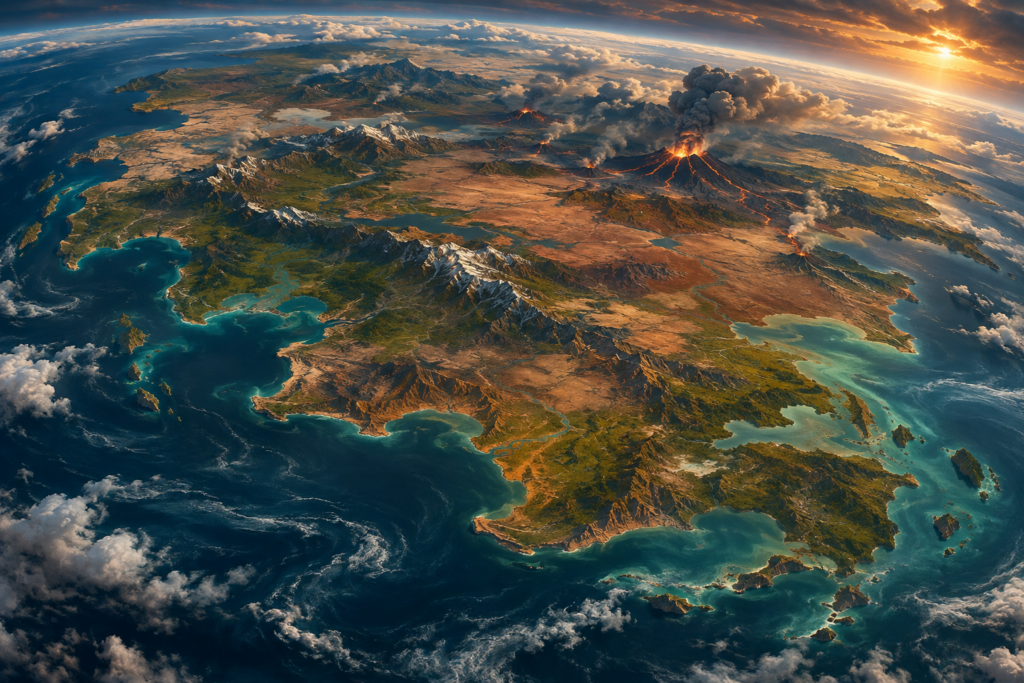
Genesis then speaks of the waters gathering and dry land appearing.
My first thought was Pangaea, the famous supercontinent whose landmasses later separated into today’s continents. But Pangaea was by no means Earth’s first supercontinent. The US Geological Survey dates it to approximately 300–200 million years ago and describes how its break-up helped open the Atlantic Ocean (USGS, n.d.b).
Much earlier came Nuna, also known as Columbia, which began assembling around 1.9–1.8 billion years ago and may have reached its more complete configuration around 1.6 billion years ago. Some researchers regard Nuna as the earliest well-supported supercontinent; still older arrangements have also been proposed, although the evidence and terminology remain debated (Kirscher et al., 2022).
Even Nuna was not the first dry land. Earth had developed continental crust long before its assembly, so I cannot equate Genesis 1:9–10 with any single named supercontinent.
What resonates with me is the larger picture: Earth’s land has emerged, moved, joined and separated over immense stretches of time. The biblical image of waters and land becoming distinct speaks to me of a changing world.
There is a fascinating pattern here, known as the supercontinent cycle. Over hundreds of millions of years, moving tectonic plates draw continents together into enormous landmasses, which later split apart and disperse. Researchers describe repeated episodes of assembly and break-up, often separated by roughly 500 million years, although this is not a perfectly regular timetable. These changes can also influence sea levels and climate (Nance, 2022).
Genesis describes dry land appearing once, not this repeated cycle, but the discovery makes me appreciate just how dynamic the Earth has always been.
Vegetation and a Changing Atmosphere (Genesis 1:11–13)

Genesis describes the Earth producing vegetation before the appearance of the animals in later verses.
I connect this with the extraordinary role photosynthesis has played in making Earth suitable for complex life. Long before forests existed, microscopic organisms in the oceans were releasing oxygen. Over enormous periods, photosynthetic life transformed the atmosphere.
The Smithsonian National Museum of Natural History explains that evidence of microscopic life reaches back about 3.7 billion years, while cyanobacteria were producing oxygen through photosynthesis by at least 2.4 billion years ago. This contributed to a profound change in the atmosphere, recorded in the chemistry of ancient rocks (Smithsonian National Museum of Natural History, n.d.).
The oxygen-making pioneers were microbes, not the seed-bearing plants and fruit trees described in Genesis. Those plants evolved much later than the earliest marine animals. Even with that difference in the sequence, the immense transformation brought about by photosynthesis fills me with wonder. I can appreciate the connection between life, vegetation and a habitable world without treating the passage as a fossil record.
The Sun, Moon and Stars Become Visible (Genesis 1:14–19)

The fourth day interests me because the Sun, Moon and stars are described after light has already appeared.
One possible way of imagining this is that Earth’s atmosphere gradually became clearer, allowing the heavenly bodies to become visible from the surface. It is a reading that I find worth considering.
There is another interpretation I find fascinating. In Chapter 5, “Sight”, of The Genesis Enigma, evolutionary biologist Andrew Parker (2010) connects this stage not with the physical creation of the Sun and Moon, but with the evolution of image-forming vision in early animals. In his account, the lights were already there; what changed was that living creatures could now see them. Parker’s related “light-switch” hypothesis proposes that evolving eyes helped transform predator–prey relationships during the Cambrian Period, when animal life diversified dramatically more than 500 million years ago.
This is different from saying that microbes developed a retina. Some microorganisms possess light-sensitive proteins that use a molecule called retinal, but Parker’s argument concerns the development of sight in multicellular animals. His interpretation is intriguing, though the precise role of vision in the Cambrian explosion—and the proposed connection to Genesis 1:14–19—remain open to debate.
The Natural History Museum describes fossils of early arthropods with complex eyes and even preserved nervous tissue, including specimens around 517 million years old. It also discusses the possibility that improved vision intensified relationships between predators and prey during the Cambrian diversification (Hazlehurst and Hendry, n.d.). This gives Parker’s proposal a genuine evolutionary subject to discuss.
Genesis itself speaks of God making and appointing the lights, not of clouds clearing or eyes evolving. The Sun and Moon existed billions of years before land plants or human observers, so Parker’s suggestion remains an interpretation, not an established explanation of the fourth day.
What the text explicitly emphasises is their purpose in marking days, seasons and years. Theologically, they are part of creation, not gods to be worshipped.
Life in the Seas, Then Life on Land (Genesis 1:20–25)
[24] And God said, “Let the earth bring forth living creatures according to their kinds—livestock and creeping things and beasts of the earth according to their kinds.” And it was so. [25] And God made the beasts of the earth according to their kinds and the livestock according to their kinds, and everything that creeps on the ground according to its kind. And God saw that it was good.

This is perhaps the parallel I find most intriguing.
Genesis first describes the waters teeming with living creatures. Only afterwards does it turn to animals on the land. Fish are specifically mentioned a little later, in Genesis 1:26. The passage does not provide a biological family tree, but it paints a picture of abundant life in the seas before the land is filled with animals. That broad movement from water to land is what catches my attention.
The scientific story begins much earlier than fish. The oldest signs of life are microscopic, and for billions of years Earth’s oceans were home to organisms far simpler than the animals we see today. Complex animal life diversified dramatically during the Cambrian Period, more than 500 million years ago. The fossil record then reveals an astonishing variety of marine creatures, including early fish and other vertebrates (Dunning, n.d.a).
Genesis does not say that microbes were absent, or that the sea creatures it names were the first living organisms. Its silence about microscopic life is not a denial of its existence. To my mind, that is an important distinction when comparing an ancient text with discoveries made possible by microscopes.
What happened as animals began colonising land is even more remarkable. This was not one sudden leap. Early arthropods, including relatives of modern millipedes and arachnids, were among the first animals to establish themselves on land. Their fossils date to the Silurian Period, roughly 443–419 million years ago. Vertebrates followed later, evolving adaptations that allowed some descendants of fish to support their bodies and move in shallow water and eventually on land (Dunning, n.d.a).
One fossil I find especially compelling is Tiktaalik, an animal that lived around 375 million years ago. It had unmistakably fish-like features, including scales and fins, but also a mobile neck and strong fin bones with wrist-like joints.
It was not necessarily the direct ancestor of every land vertebrate; rather, it gives us a glimpse of the gradual changes involved in the transition between aquatic and terrestrial life (Dunning, n.d.b). When I think of that long transformation, the biblical movement from waters full of creatures to animals on land seems especially evocative.
There is, however, a genuine difference in the order of birds. Genesis groups them with sea creatures on the fifth day, before the land animals of the sixth. Fossils show that birds evolved much later from theropods, a group of mostly two-legged dinosaurs, with recognisably bird-like forms appearing around 150 million years ago (Caton, n.d.). And not all land animals descended from fish: different groups, such as arthropods and vertebrates, made the transition independently.
Even with those differences, I find the broad movement from living waters to land animals intriguing. Reading the passage alongside the fossil record opens up a sense of wonder rather than closing down the discussion.
Finally, Humanity (Genesis 1:26–31)
[27] So God created man in his own image,
in the image of God he created him;
male and female he created them.
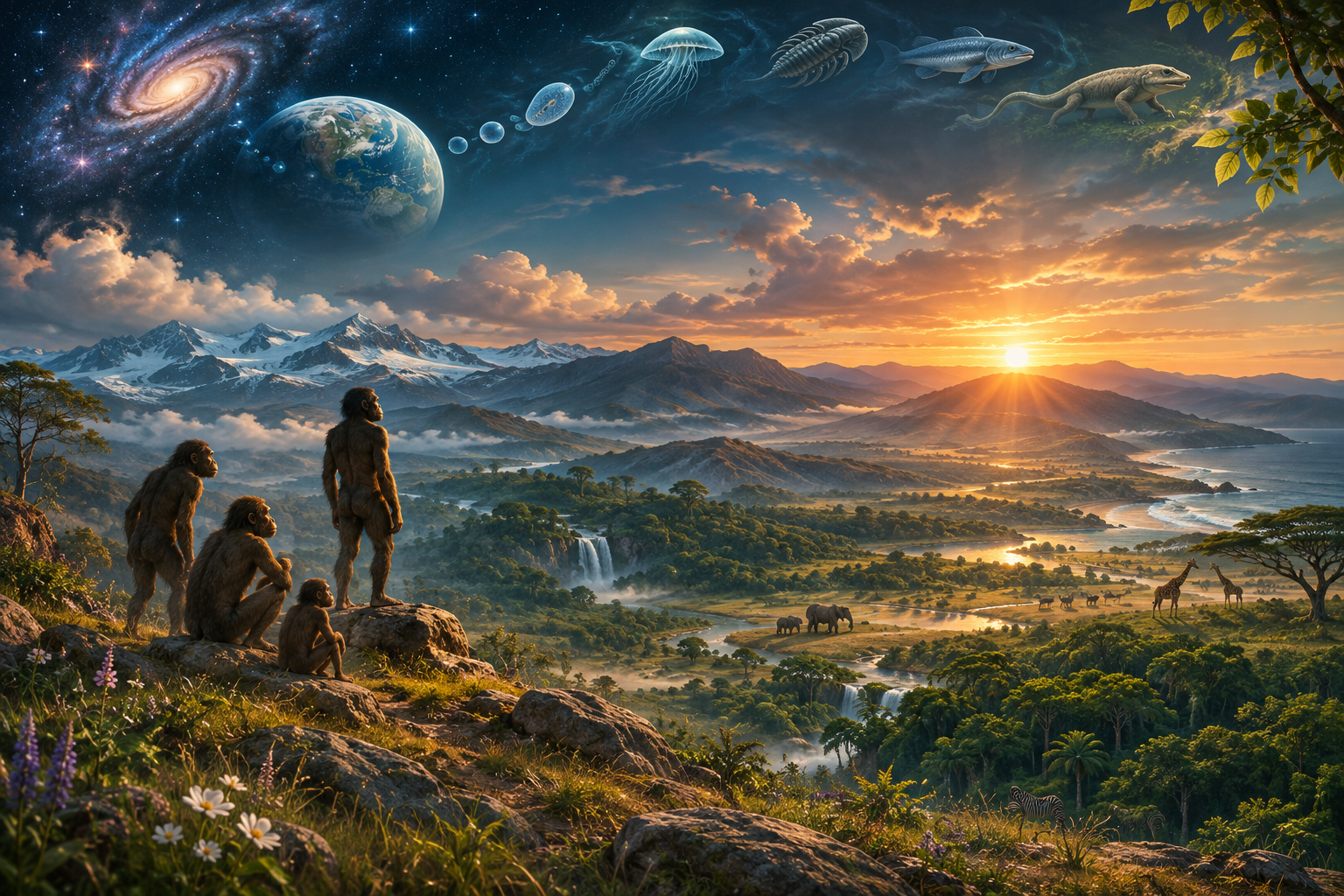
After the other living creatures, Genesis turns to human beings.
That order also catches my attention. In the history of life, humans are very recent arrivals. Our evolutionary lineage stretches back millions of years through earlier hominins—humans and our extinct evolutionary relatives. Our own species, Homo sapiens, appeared about 300,000 years ago.
The Natural History Museum traces a branching human family tree back roughly seven million years, using fossil skulls, teeth and bones to investigate how different hominins lived and developed. It emphasises that our ancestry was not a simple straight line from one species to the next (Wong and Hendry, n.d.). For me, this makes humanity’s place near the end of the Genesis account particularly thought-provoking, while also reminding me how much more complex our actual biological history is.
I see no reason why this biological ancestry must exclude belief in a Creator. We can be part of the natural history of life and still understand ourselves as bearing a particular responsibility within it.
For me, being made in God’s image is not necessarily a statement about a sudden biological transformation at one identifiable moment in prehistory. I understand it as a profound claim about human dignity, moral responsibility and our relationship with God and the world.
But that phrase, in God’s image, also makes me think about DNA. Every living organism carries genetic information, and the similarities in our DNA help scientists trace the connections between species. Yet Genesis speaks of many living creatures and then singles out humanity as bearing God’s image. What, then, is different about us?
It brings to mind the old search for the missing link between our earlier ancestors and modern humans. That expression makes evolution sound like a chain with one missing piece. In reality, fossils and DNA reveal a branching family tree, and researchers have not identified one precise time or place when all the characteristics of modern humanity suddenly appeared (Pavid, 2021).
That leaves me with a question I cannot shake: If humanity gradually evolved through earlier species, was being made in God’s image something that happened at a particular point, or is it a description of humanity’s relationship with God rather than a biological event?
Did capacities such as self-awareness, moral responsibility and spiritual understanding develop gradually? And could God have worked through that long history? These are questions of faith and interpretation, not claims that DNA contains a detectable mark of divinity. Our genes can tell us about our ancestry; they cannot, on their own, tell us whether our lives have a God-given purpose.
Why Does Genesis Say “Day” Instead of “Stage”?
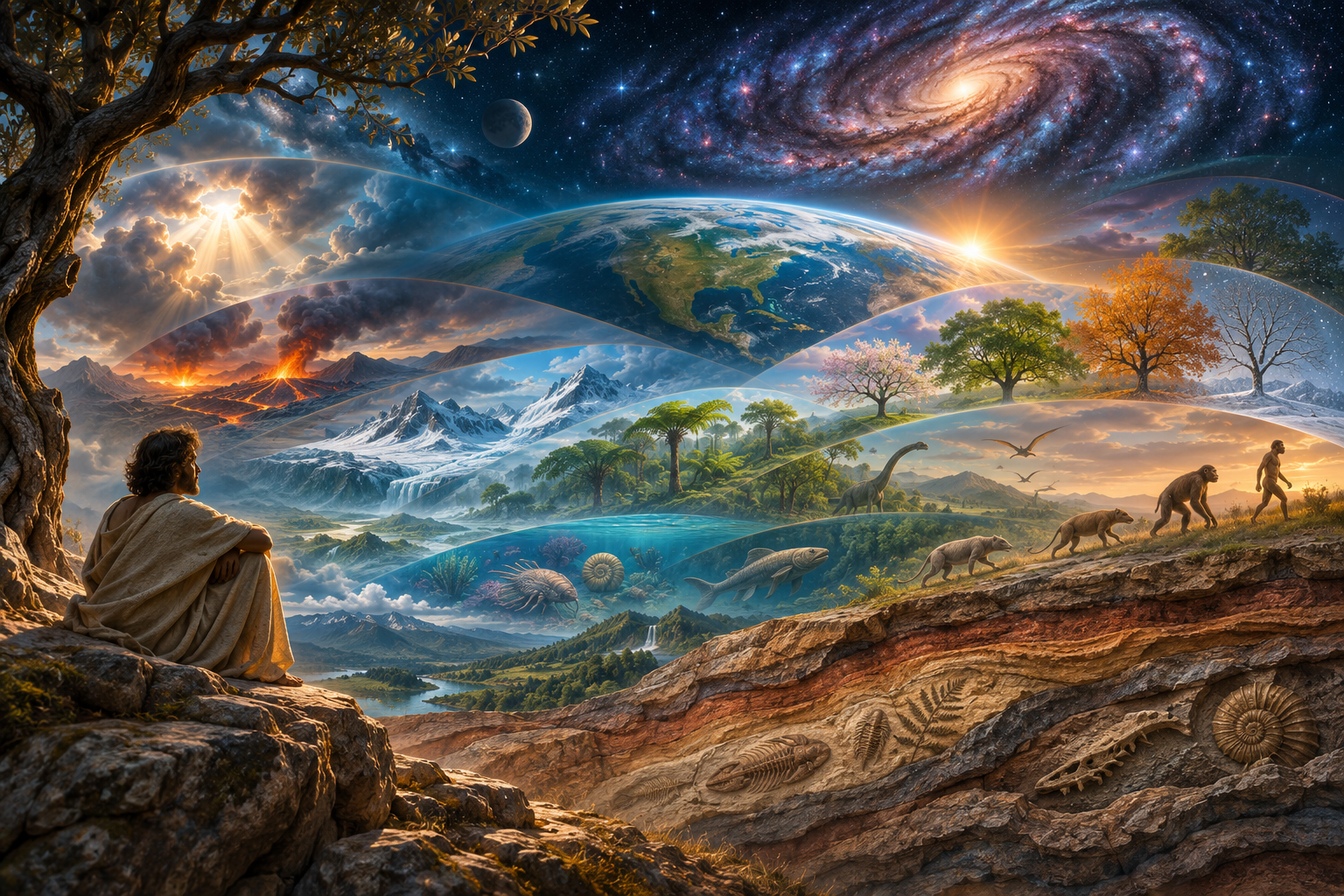
Having followed the Genesis account from the formation of Earth to the appearance of humanity, I find myself returning to a fundamental question: what exactly does the writer mean by a day?
If God exists beyond the limits of time and space, why should creation be measured in units defined by the rotation of one small planet? Would a being who can see the beginning and end of history experience time in the linear way that we do?
As a science-fiction fan, I think of the Prophets—the wormhole aliens—in Star Trek: Deep Space Nine. They do not experience time as human beings do. For Benjamin Sisko, events have a before and an after; for the Prophets, the relationship between past, present and future is something entirely different.
Of course, fictional aliens are not a model of God. But the story helps me imagine why our ordinary language of time might be inadequate. Revelation 22:13 describes the divine speaker as the Alpha and the Omega, the beginning and the end. I find that image suggestive of a perspective on history far beyond my own, although the verse does not by itself settle the philosophical question of whether God is outside time.
That makes me want to read Genesis in terms of stages of creation, rather than assuming six consecutive 24-hour intervals. The word stage expresses what I mean when I consider the immense timescales discovered by science.
Those timescales are supported by measurements, not simply guesses. Geologists can use the known rates of radioactive decay in minerals to estimate the ages of rocks—a method called radiometric dating—and compare those results with the sequence preserved in rock layers and fossils (USGS, n.d.a).
That is how we can investigate events separated by millions or billions of years, even though nobody was there to observe them directly. It does not tell us how to translate the Hebrew word day, but it does explain why I hesitate to confine the whole history of Earth to six ordinary days.
But should we actually replace day in the Bible? I don’t think so. The Hebrew word yom really does mean day, although it can refer to time more generally in other contexts. In Genesis 1, the repeated evenings and mornings are part of the writing, and the seventh day leads to the biblical idea of Sabbath rest. Substituting stage in a translation would erase something important from the original text.
I would keep the word day and explain that I am interpreting those days as literary stages—not claiming to have found a better translation.
Does That Make the Scientific Sequence Accurate?
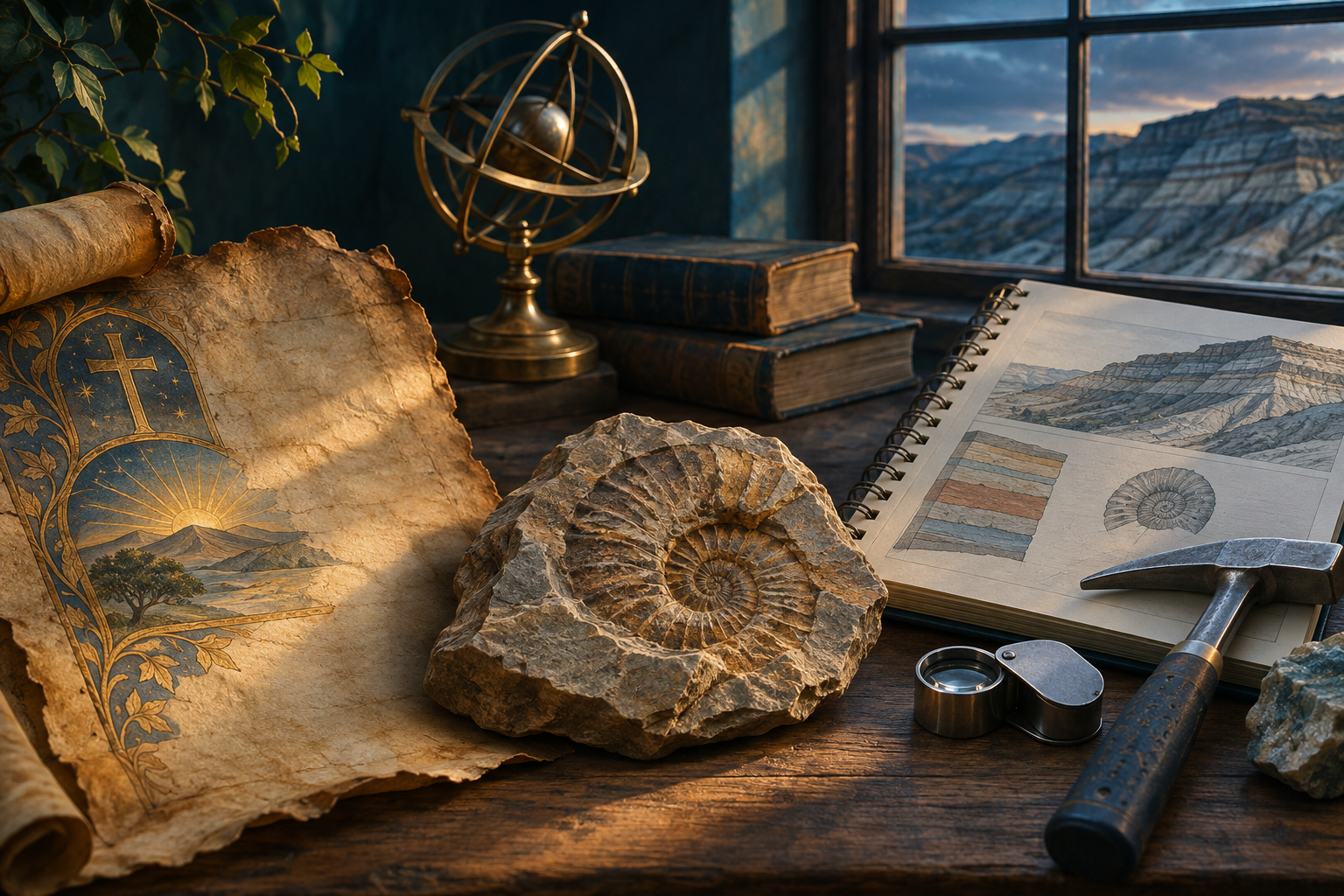
It makes my understanding of the passage more coherent, but it does not settle everything. This is where I think honesty matters most.
If we insist that each creation day corresponds exactly to a period of geological history, difficulties quickly appear. The Sun is introduced after vegetation. Birds are grouped with marine creatures, although they evolved from land-dwelling dinosaurs. Fruit trees are described before animal life, rather than much later in the story.
These are not merely objections based on how the story sounds to a modern reader. Fossils place complex marine animals more than 500 million years ago, the movement of different animal groups onto land later, bird-like dinosaurs around 150 million years ago, and flowering plants much later than the earliest animals (Dunning, n.d.a; Caton, n.d.). It matters that we test an apparent parallel against this evidence instead of highlighting only the parts that seem to fit.
There is also a literary pattern in Genesis 1. The first three days distinguish realms—day and night, sky and waters, sea and land. The following three days populate those realms with lights and living creatures. It is a carefully shaped account of order, not a list of fossil dates.
BibleProject describes Genesis as a story in which God brings order, beauty and a home for life out of darkness and disorder (BibleProject, n.d.a). Its exploration of the number seven also connects the creation week with completeness and the Sabbath pattern of work and rest (BibleProject, n.d.b). Those themes help explain why the writer might have chosen a seven-day structure for theological reasons, even if the events should not be treated as seven entries in a scientific timeline.
For me, recognising that structure does not weaken the passage. It helps me ask what the ancient author was trying to communicate to the people who first heard it.
Changing day to stage in our interpretation addresses the question of duration. It does not fix differences in the order of events. I do not need to claim that every scientific discovery was secretly recorded in Genesis to believe that creation and evolution can describe the same reality from different perspectives.
How Could an Ancient Writer Come So Close?
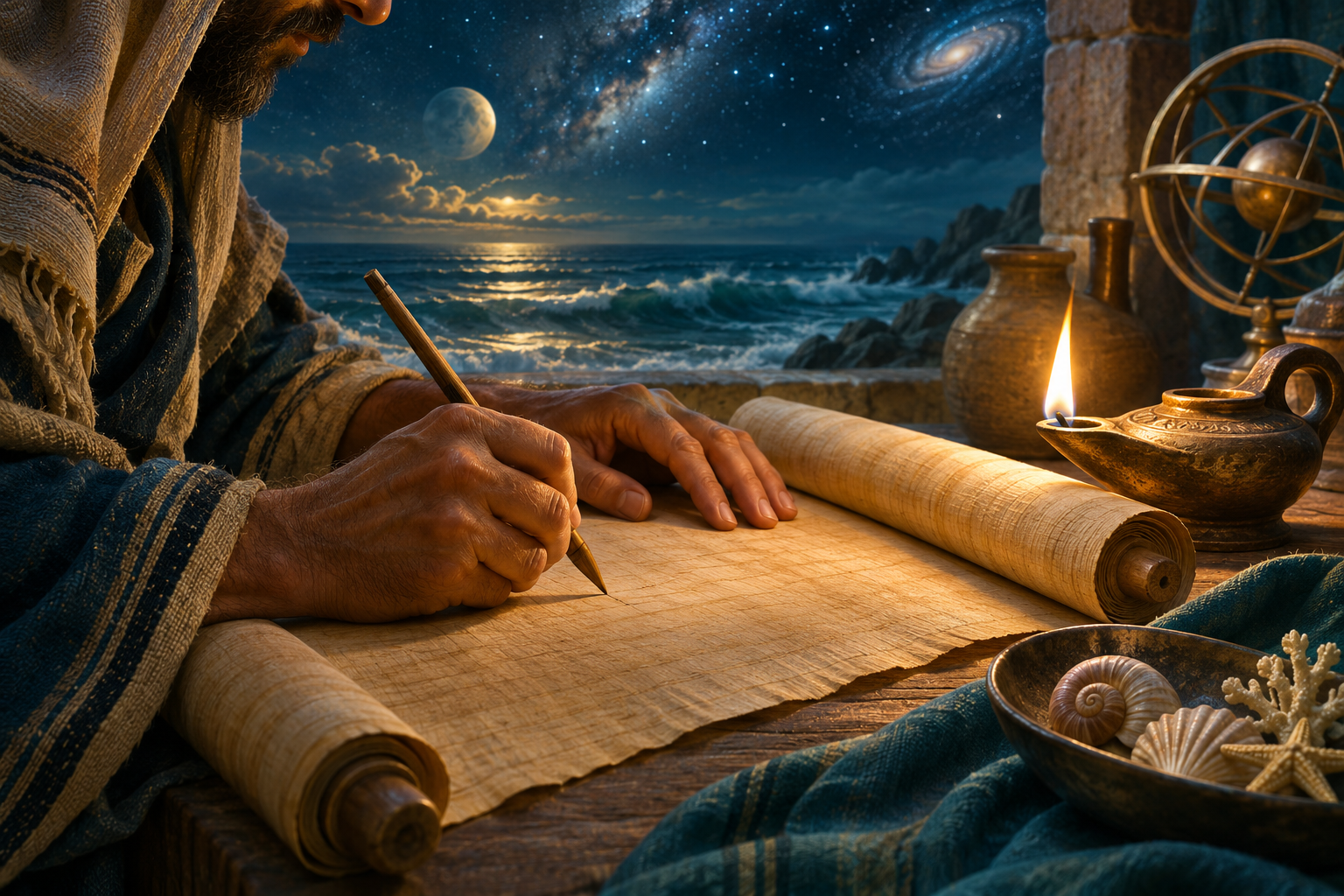
This is, for me, the most interesting question of all. Genesis is an ancient text, written long before telescopes, microscopes, modern geology or the fossil evidence that helped us understand evolution. Yet its broad picture of a world becoming ordered and filled with life can sound surprisingly familiar.
Modern scientific chronology is assembled from evidence that ancient writers could not have examined in the same way: fossil-bearing rock layers, the relationships between those layers, and radiometric measurements that assign numerical ages to suitable minerals (USGS, n.d.a). That makes me more curious about the similarities I notice, but it also reminds me that we must compare the two accounts carefully rather than assume they are describing the same sequence.
I wonder how much the human perspective of its writer—or writers—shaped the details. We all know how easily people can arrange events in the wrong order when retelling a story, or allow assumptions to influence what they think happened. Perhaps ancient understandings, inherited traditions and the desire to communicate a particular message influenced the sequence in Genesis too.
Of course, nobody was an eyewitness to the formation of Earth or the beginnings of life. So it would not be accurate to say the writer was simply remembering those events incorrectly. Biblical scholars also debate how the traditions behind Genesis were composed and edited over time. Its careful seven-day structure suggests literary choices, not a casual attempt to jot down a chronology.
As a Christian, I remain open to the possibility of divine inspiration expressed through the language and understanding of human authors. That does not require their knowledge of nature to have been unlimited or their account to operate as a scientific report.
When I say Genesis seems almost accurate, I mean that I find several of its broad connections remarkable—not that every stage matches the scientific record. Some comparisons are stronger than others, and some may be similarities we notice because we already know what science has discovered.
Still, after so many centuries, I think the resemblance is worth questioning rather than simply dismissing. How did an ancient account arrive at a picture that continues to provoke such comparisons with what we now know?
Why Do We Have to Choose?
[1] The heavens declare the glory of God,
and the sky above proclaims his handiwork.
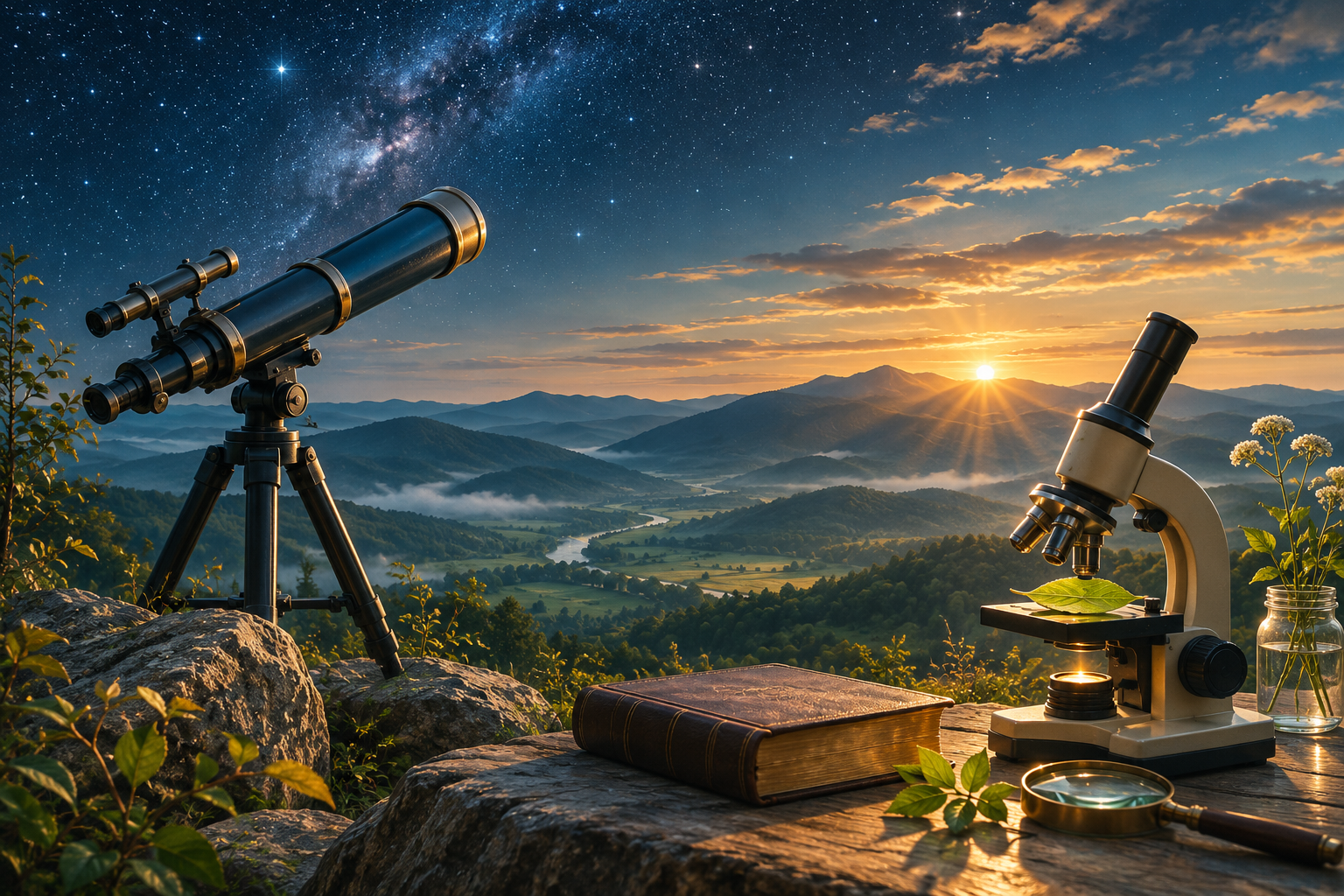
When someone asks whether I believe in creation or evolution, I think they are presenting me with a false choice.
Evolution is a scientific theory supported by evidence about how populations change and share ancestry. Creation is my theological belief that the universe and life ultimately owe their existence to God. They are not identical kinds of explanation, but I believe they can belong to one account of reality.
The Smithsonian’s Human Origins Program explains that evolution is a well-tested scientific theory supported by extensive evidence. It also acknowledges that some people see a conflict between evolution and religion, while others—including scientists who hold religious beliefs—see room for dialogue or compatibility (Smithsonian Human Origins Program, n.d.). I find that a useful reminder that accepting scientific evidence does not, by itself, dictate someone’s theological conclusions.
Far from diminishing my sense of wonder, the billions of years involved make it deeper. The gradual emergence of oceans, complex organisms, forests, birds and human beings is extraordinary.
Perhaps faith and science need not be afraid of each other’s questions. One encourages me to investigate how the world works. The other challenges me to consider why it matters, and how I ought to care for it.
Knowledge, Science and Responsibility
There is another idea that has stayed with me from Wendy Alec’s novel The Fall of Lucifer. It imagines the creation of humanity and Lucifer’s rebellion from a perspective very different from the one we find in Genesis. I was particularly struck by the way the novel connects forbidden knowledge with science and technology.
In Chapter 25, The Verdict, the character Jether refers to:
“The forbidden angelic illuminations of the scientific arts” (Alec, 2008, ch. 25).
He goes on to name fields of knowledge such as astrophysics, earth sciences and electricity. In the preceding chapter, The Demon Seed, Lucifer’s followers discuss passing technological knowledge to humanity so that people will use it to make weapons and destroy one another (Alec, 2008, ch. 24).
What interests me is the distinction between knowledge itself and what we do with it. In Alec’s fictional world, knowledge becomes a means of manipulation and destruction. That makes me think about the tree of the knowledge of good and evil in Genesis.
Genesis itself never identifies the forbidden fruit with science. It calls the tree the tree of the knowledge of good and evil (Genesis 2:17), and it never says the fruit was an apple. Alec’s imagined angelic revelations are a fictional interpretation, not an explanation supplied by Genesis.
Perhaps the more challenging question is this: does knowledge separate us from God, or can the misuse of knowledge separate us from one another and from what is good? Scientific discoveries can help us develop weapons, but they can also help us cure diseases, protect the planet and understand the universe. The moral question lies in how we choose to apply what we learn.
Scientific curiosity is not, to my mind, an act of rebellion against God. Understanding how a star forms, why species change, or how a cell works can deepen my appreciation of creation. Faith and science will sometimes challenge one another, but neither curiosity nor evidence needs to be treated as the enemy.
The Mathematics of Creation
There is another question that fascinates me: Why is the universe so remarkably well described by mathematics?
From the movements of planets and the behaviour of atoms to the genetic processes that underpin evolution, mathematics allows us to understand and predict aspects of the natural world with extraordinary precision.
Planetary motion offers a concrete example. NASA explains that Kepler’s laws describe the shapes of planetary orbits, how a planet’s speed changes along its orbit and the mathematical relationship between its distance from the Sun and its orbital period (NASA, n.d.c). That predictive power is remarkable in its own right. Whether it has a deeper theological meaning is a separate question.
Does this mathematical order point towards a Creator, or is it simply a reflection of how the universe works? Mathematics cannot prove God’s existence, but I find it remarkable that a universe of such extraordinary complexity can be understood through mathematical principles.
I like to think of God as the ultimate scientist—not as a replacement for mathematics, physics, chemistry, biology or evolution, but as the source of a universe whose processes are worth investigating. That is a statement of faith, of course, rather than a scientific conclusion. For me, the more we learn about the processes of nature, the more astonishing creation becomes.
Why should I have to choose between believing that God created the universe and accepting the evidence for how it developed? I believe both can be true. Perhaps creation and evolution are not rival answers, but different parts of the same story.
References
Alec, W. (2008) The Fall of Lucifer. London: Warboys Publishing.
BibleProject (n.d.a) Book of Genesis. Available at: https://bibleproject.com/guides/book-of-genesis/ (Accessed: 4 November 2026).
BibleProject (n.d.b) The significance of seven. Available at: https://bibleproject.com/podcasts/significance-7/ (Accessed: 4 November 2026).
Caton, E. (n.d.) ‘What were the first birds like?’, Natural History Museum. Available at: https://www.nhm.ac.uk/discover/what-were-the-first-birds-like.html (Accessed: 4 November 2026).
Dunning, H. (n.d.a) ‘The origin of life on Earth: From basic chemicals to complex organisms’, Natural History Museum. Available at: https://www.nhm.ac.uk/discover/origin-of-life-on-earth.html (Accessed: 4 November 2026).
Dunning, H. (n.d.b) ‘Prehistoric fish: 11 of the largest, weirdest and most significant’, Natural History Museum. Available at: https://www.nhm.ac.uk/discover/prehistoric-fish-timeline.html (Accessed: 4 November 2026).
Elliott, R. (2026) ‘Bible TL;DR: Genesis – Beginnings, Brokenness and a Promise’, Rob’s Roost. Available at: https://robsroost.me.uk/bible-tldr-genesis/ (Accessed: 4 November 2026).
Hazlehurst, K. and Hendry, L. (n.d.) ‘Eyes on the prize: the evolution of vision’, Natural History Museum. Available at: https://www.nhm.ac.uk/discover/eyes-on-the-prize-evolution-of-vision.html (Accessed: 4 November 2026).
Kirscher, U., Mitchell, R.N., Liu, Y., Pisarevsky, S.A., Giddings, J. and Li, Z.-X. (2022) ‘Paleomagnetic evidence for a Paleoproterozoic rotational assembly of the North Australian Craton in the leadup to supercontinent formation’, Geophysical Research Letters, 49(22), e2022GL099842. Available at: https://doi.org/10.1029/2022GL099842 (Accessed: 4 November 2026).
NASA (n.d.a) Chapter 2: Reference Systems. Available at: https://science.nasa.gov/learn/basics-of-space-flight/chapter2-1/ (Accessed: 4 November 2026).
NASA (n.d.b) How did our Solar System form? Available at: https://science.nasa.gov/astrobiology/learning-resources/alp/how-did-our-solar-system-form/ (Accessed: 4 November 2026).
NASA (n.d.c) Orbits and Kepler’s Laws. Available at: https://science.nasa.gov/solar-system/orbits-and-keplers-laws/ (Accessed: 4 November 2026).
Nance, R.D. (2022) ‘The supercontinent cycle and Earth’s long-term climate’, Annals of the New York Academy of Sciences, 1515(1), pp. 33–49. Available at: https://doi.org/10.1111/nyas.14849 (Accessed: 4 November 2026).
Parker, A. (2010) The Genesis Enigma. London: Black Swan.
Pavid, K. (2021) ‘Modern human origins cannot be traced back to a single point in time’, Natural History Museum, 10 February. Available at: https://www.nhm.ac.uk/discover/news/2021/february/modern-human-origins-cannot-be-traced-back-to-a-single-point.html (Accessed: 4 November 2026).
Smithsonian Human Origins Program (n.d.) Frequently Asked Questions. Available at: https://humanorigins.si.edu/education/frequently-asked-questions (Accessed: 4 November 2026).
Smithsonian National Museum of Natural History (n.d.) Early life on Earth – animal origins. Available at: https://naturalhistory.si.edu/education/teaching-resources/life-science/early-life-earth-animal-origins (Accessed: 4 November 2026).
United States Geological Survey (USGS) (2019) The atmosphere and the water cycle. Available at: https://www.usgs.gov/water-science-school/science/atmosphere-and-water-cycle (Accessed: 4 November 2026).
United States Geological Survey (USGS) (n.d.a) Geologic Age: Using Radioactive Decay to Determine Geologic Age. Available at: https://www.usgs.gov/educational-resources/geologic-age-using-radioactive-decay-determine-geologic-age (Accessed: 4 November 2026).
United States Geological Survey (USGS) (n.d.b) What was Pangea? Available at: https://www.usgs.gov/faqs/what-was-pangea (Accessed: 4 November 2026).
Wong, J. and Hendry, L. (n.d.) ‘The origin of our species’, Natural History Museum. Available at: https://www.nhm.ac.uk/discover/the-origin-of-our-species.html (Accessed: 4 November 2026).
Further reading
For the biblical passages, use the ESV excerpts supplied in each section above. For an overview of Genesis as a whole, see Elliott (2026). The quotation from Alec was verified against the supplied EPUB and is identified by chapter rather than a device-dependent ebook page number. The connection I draw between her novel and the forbidden fruit in Genesis is my own reflection.
This article reflects my own Christian understanding of creation and evolution. It is an invitation to explore both Scripture and scientific evidence thoughtfully, not a claim that Genesis is a modern science textbook.
Scripture quotations are from The Holy Bible, English Standard Version® (ESV®). Copyright © Crossway.

Comments