
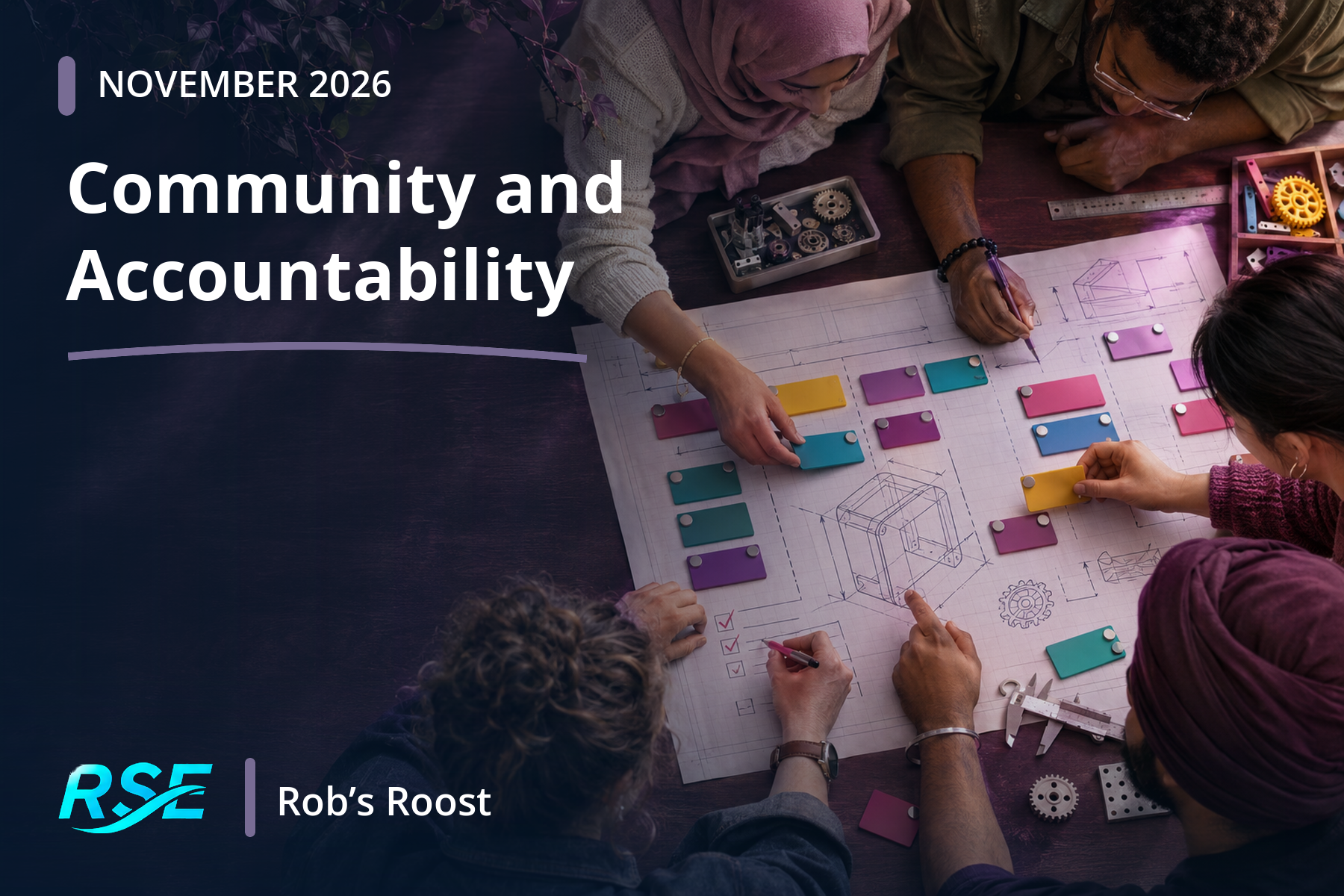
Team culture is not the slogan on an office wall. It is what happens when a deadline slips, a junior developer asks a question or somebody admits a mistake.
Why this matters
Healthy teams combine psychological safety with clear standards. People should be able to challenge decisions and disclose uncertainty, while still being responsible for the quality of their work.
Practices that shape us
Good leadership makes priorities explicit, protects sustainable workloads, documents decisions and shares credit. It does not reward permanent emergency or confuse long hours with commitment.
Where things become difficult
Conflict is inevitable. Teams need ways to disagree about architecture, scope and risk without turning technical decisions into personal battles.
A better way forward
Culture is built in small repeated actions: useful reviews, fair incident analysis, respectful meetings, realistic planning and the quiet willingness to help a colleague succeed.
Questions to consider
- Where am I relying on individual effort when shared responsibility would be healthier?
- What could I do this week to listen more carefully and make accountability easier?
- Which practice would help this community become more truthful, welcoming and sustainable?
Community grows through habits, not slogans. The next step is to put one of these principles into practice and notice what changes.
A culture of candour
A healthy team can discuss difficult news without turning it into a personal attack. When a deadline is slipping, people should be able to explain why. When an engineer spots a risk, they should be encouraged to raise it before an incident occurs. Candour does not mean rudeness. It means describing reality accurately enough that the group can make a responsible decision. Leaders set the example when they admit their own errors and thank colleagues for surfacing uncomfortable facts.
Clear expectations
Ambiguous responsibilities create avoidable conflict. People need to know who owns a service, who approves releases and what standards a change must meet. Expectations should be written and accessible rather than transmitted through informal relationships. This helps newcomers and makes accountability fairer. Clear roles do not prevent collaboration; they give it structure. A person can contribute to a shared problem while knowing who has the authority to make a final decision.
Support and challenge
Psychological safety is sometimes mistaken for the absence of criticism. In a strong team, people can question a design and receive direct feedback without humiliation. Standards remain high, but feedback focuses on evidence and behaviour. A code review should identify risks and explain trade-offs. A performance conversation should address specific actions and provide a route to improvement. People are more willing to take responsibility when they know a mistake will be examined fairly.
Workload and recovery
A team that is always in crisis will struggle to learn. Permanent overtime reduces attention and increases the likelihood of further errors. Planning needs to include testing, maintenance, documentation and unexpected problems. After a serious incident, responders need recovery time. Leaders should examine recurring emergencies rather than praise heroics indefinitely. Sustainable work is not a luxury. It is one of the conditions required for reliable engineering.
Meetings with purpose
Meetings should help people make decisions, coordinate dependencies or resolve questions that benefit from conversation. They should not consume every hour available for concentrated work. A written proposal can allow colleagues to consider a problem before discussion. Decisions should be recorded afterwards so absent people are not excluded. Teams can improve collaboration by reducing unnecessary meetings while making essential conversations more thoughtful and inclusive.
Respectful technical disagreement
Two engineers may reasonably favour different designs. One values simplicity; another anticipates future scale. A healthy discussion makes assumptions visible and asks what evidence could distinguish the alternatives. Small experiments and tests may resolve uncertainty. When a judgement call remains, the responsible person should document the choice and its trade-offs. Disagreement need not become a contest of status. It can reveal information the team would otherwise miss.
Recognising invisible contributions
Some of the most important work produces little visible output. A colleague helps somebody understand a difficult component, updates a runbook or fixes a flaky test. Another notices that a release process could expose customer data. These contributions protect the whole team, but they can be overlooked when recognition focuses only on feature delivery. Healthy cultures thank people for maintenance, mentoring and risk reduction as well as for launching new functionality.
A fair start for newcomers
Onboarding reveals how much a team depends on undocumented assumptions. Can a new developer set up the project? Are access requests straightforward? Do they know where to ask questions? A clear onboarding guide, a small first task and a supportive reviewer help people become confident contributors. Newcomers also provide useful feedback about confusing processes. Their questions can expose weaknesses that experienced colleagues have stopped noticing.
Distributed work
Hybrid and remote teams need deliberate communication. Important decisions made in an office conversation should be documented for colleagues elsewhere. Meeting schedules should consider time zones and caring responsibilities. Written discussion can help people who prefer time to reflect before responding. Inclusion is not simply inviting everyone to a call. It is making sure they have the information and opportunity needed to influence the work.
Responding to incidents
An outage tests the team’s habits. Clear responsibilities, useful monitoring and calm communication help restore service. Afterwards, a review should examine why the failure occurred and which safeguards were missing. Blaming an individual may feel decisive but often leaves systemic problems untouched. Action items need owners and realistic deadlines. The team should preserve what worked as well as correct what failed.
Building trust through repetition
Trust grows when colleagues keep commitments, admit uncertainty and treat one another consistently. A manager who promises support but punishes questions undermines trust. A reviewer who is patient with senior colleagues but harsh with junior developers does the same. Culture is formed through repeated small interactions. The aim is not universal agreement or constant positivity. It is a working environment where people can contribute, learn and be accountable without fear of humiliation.
A practical starting point
Choose one improvement for the next month. Document a decision that would otherwise remain informal. Introduce a useful pull-request template. Protect a regular period for maintenance. Ask colleagues whether they can raise concerns safely. Review whether the same people are repeatedly carrying emergency work. Small, sustained changes are more credible than an ambitious culture statement that never affects everyday behaviour. The healthiest teams make their values visible in the way work is actually done.
Psychological safety is not the absence of standards
A healthy team makes it possible to admit uncertainty and report mistakes without humiliation. That does not mean every proposal is accepted or every error excused. Standards remain important, particularly where security, reliability and customer data are involved. The distinction is between holding people responsible for their work and treating them as disposable when something goes wrong. A developer who reports a risky assumption early should be thanked for making the problem visible. A colleague who repeatedly ignores an agreed process still needs constructive feedback. Safety and accountability reinforce each other when expectations are clear and consequences are fair.
What leaders reward becomes culture
A team may claim to value collaboration while praising only the person who works through the weekend to rescue a release. That sends a message: heroic recovery matters more than sustainable preparation. Managers can reward different behaviour by recognising documentation, mentoring, preventative maintenance and honest risk reporting. They can protect time for training and make it acceptable to challenge unrealistic deadlines. Leaders also set the tone when they admit their own mistakes. A manager who asks for feedback but reacts defensively teaches colleagues to remain silent. Culture is revealed through repeated decisions, not through slogans on a presentation slide.
An example of workload becoming a risk
Suppose one developer knows how to deploy a critical service. Every urgent release depends on their availability, and the rest of the team assumes that the arrangement is efficient. Eventually that person takes leave or becomes ill. What looked like expertise has become an operational weakness. A healthier team documents the deployment process, rehearses recovery and ensures another colleague can perform the work safely. The aim is not to diminish the specialist’s contribution. It is to respect their time and protect the organisation. Shared knowledge makes the service more reliable and allows individuals to rest without anxiety.
A useful monthly culture review
Rather than launching an elaborate culture initiative, a team can ask a few practical questions each month. What work was harder than expected? Where did we rely too heavily on one person? Did somebody raise a concern that was not heard? Which recurring problem should we address before it becomes an incident? Answers should lead to a small number of owned actions. If every retrospective produces a long list that nobody completes, people will stop believing the process matters. A short review with visible follow-through can do more good than a lengthy survey whose findings disappear.
A team is more than its fastest contributors
In a strong team, people can work at different paces and still make worthwhile contributions. Thoughtful documentation may take longer to produce than a quick fix, but it can prevent repeated questions. Careful testing may slow one release and save a week of recovery later. A colleague who mentors others may write less code themselves while multiplying the team’s capability. Leaders should look beyond individual output statistics and ask whether the group is becoming more dependable. Sustainable performance means that success does not require any one person to be indispensable.
